

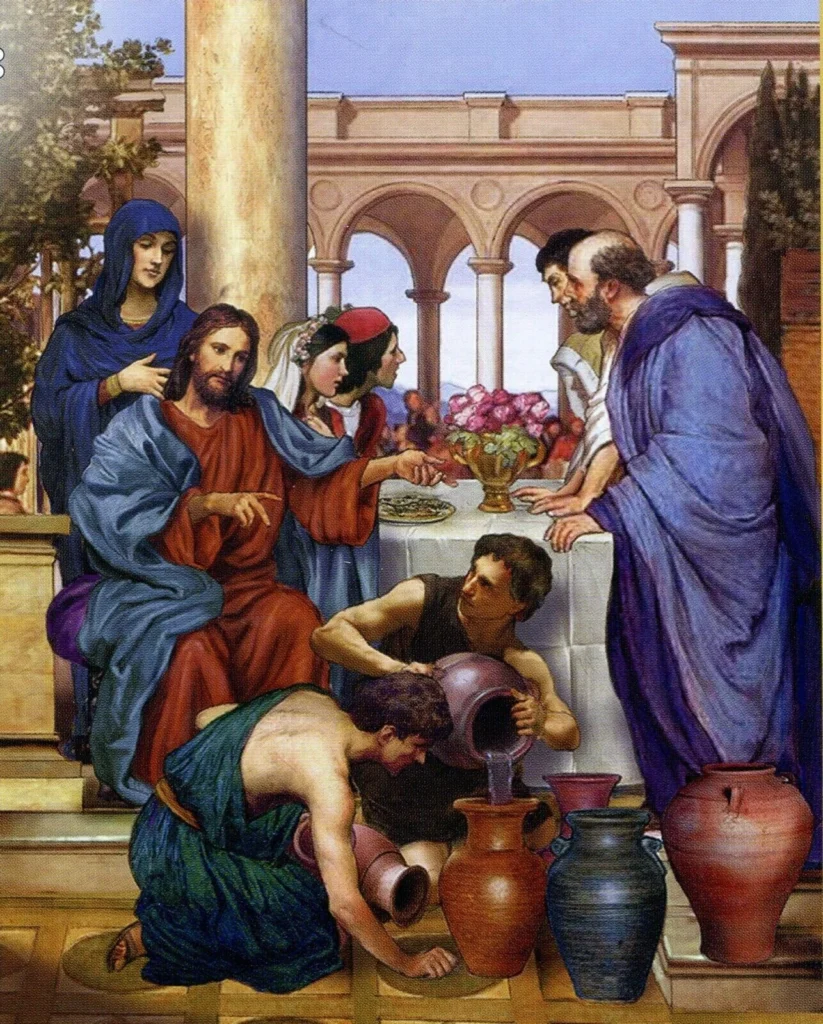
Beyond Water and Wine: 5 Surprising Truths Hidden in Jesus’s First Miracle
1.0 Introduction: The Miracle We Thought We Knew
The story of the Wedding at Cana is one of the most familiar in the Gospels. As many of us learned, it marks Jesus’s first public miracle: a compassionate act where he saves a newly married couple from social ruin by turning water into wine. It’s a beautiful story of kindness and divine power.
But some preachers have read this passage and concluded, “What’s the big deal? Mary was just there; she didn’t want the couple to be embarrassed.” To read it this way is to miss everything. This wasn’t just about saving a party. When Mary told Jesus, “They have no wine,” she was saying more than “the drinks have run out.” In the Bible, wine is a symbol of joy and abundance—a life beyond mere survival. She was announcing that the joy had ceased. The miracle that follows is a dense, symbolic event that reveals the very blueprint of Christ’s mission. Let’s explore five surprising truths that are often missed, revealing the story’s true depth.
2.0 Takeaway 1: It Wasn’t a Random Act, It Was Step One of a Three-Year Plan
The miracle at Cana was not an isolated event but the deliberate beginning of a multi-year process culminating in the Eucharist. This is a stunning insight from St. John Paul II, one so profound that even priests can miss it. As Fr. Chris Alar admits, “All my years of seminary I never caught that I caught that in the words of John Paul 2 last night.”
This insight reveals a perfect theological timeline unfolding across the three Passovers of Jesus’s public ministry, with each event providing a crucial element for the Last Supper:
- First Passover: At the Wedding at Cana, Jesus provides the wine by transforming water.
- Second Passover: A year later, He multiplies the loaves and fishes, providing the bread.
- Third Passover: At the Last Supper, He brings these two elements—the bread and the wine—together to institute the Eucharist.
This transforms the miracle from a spontaneous act of kindness into the intentional first move in God’s plan of salvation. Jesus wasn’t just solving a logistical problem; he was gathering the elements for the eternal covenant.
“So in the first Passover he changes the water into wine… Then in the second Passover what does Jesus do he changes the bread into his body… And then at the third Passover Christ has the last supper.”
3.0 Takeaway 2: Jesus Wasn’t Just a Guest, He Was the Divine Bridegroom
A small, often overlooked detail in the story carries immense significance. When the head waiter tastes the miraculous wine, he congratulates the earthly bridegroom, saying, “You have kept the good wine until now.” The irony is that the earthly groom didn’t provide it—Jesus did.
In traditional Jewish weddings, providing the wine was the duty of the groom and his family. By stepping in to supply the feast’s joy, Jesus symbolically takes on the role of the true, Divine Bridegroom. This is a revelation of his identity at the very start of his ministry. The story signals that the long-awaited Messianic Bridegroom has finally arrived to unite himself with his bride, the people of Israel, which becomes the Church. This connects directly to our understanding of the Mass as the “wedding feast of the Lamb,” where Christ is the groom and the Church is his bride.
“So what happens through Mary’s invitation is Jesus takes the role of the bridegroom… at the onset of his ministry it reveals he is the bridegroom first and foremost The bridegroom is now God himself.”
4.0 Takeaway 3: The Six Empty Jars Are Actually About You
The six stone jars mentioned in the story are not just props; they are rich with symbolism. Their number and their emptiness both carry profound messages about us.
First, the number six, to the Jews, was the number of incompleteness; seven was the number of perfection and covenant. The six jars symbolize the Old Covenant, which could cleanse externally but was ultimately incomplete. Jesus comes not to abolish the old law but to fulfill it, filling these incomplete vessels with the new, abundant wine of grace.
Second, and most importantly, the jars were empty. This is a powerful metaphor for our own spiritual lives. To be filled with God’s grace, we must first empty ourselves of ego, sin, and worldly attachments. St. Thérèse of Lisieux understood this perfectly. As Fr. Alar explains, “St Thérèse she declared that she would appear before Jesus naked with nothing Her emptiness is what allowed her to receive the fullness of mercy And what did she call that the little way.” Like the jars, we must become empty vessels to receive the “wine of the Holy Spirit.”
“to be saved we must be empty so that we like a vessel can receive all the grace from God… If your vessel you is filled with nothing but you there’s no room for God to fill it with the wine of the Holy Spirit This is the meaning of Cana”
5.0 Takeaway 4: Jesus’s Words to Mary Weren’t a Snub, But a Title
The exchange between Jesus and Mary can seem jarring. When she says, “They have no wine,” his response, “Woman, what does this have to do with me?” sounds dismissive. But the original text and its context reveal a meaning that is the exact opposite of a snub.
First, the original Greek is better translated as, “What does this have to do with us?” As Fr. Alar clarifies, “It simply means Jesus was telling her listen as guests guests are not responsible for the wine The hosts are responsible for the wine.” He isn’t dismissing Mary; he is commenting on their social role, which makes his decision to step out of that role and act even more significant.
More importantly, addressing her as “Woman” was a powerful and intentional title identifying Mary as the “new Eve.” In Genesis, the first Eve prompted the first Adam to disobey God. Here at Cana, the new Eve (Mary) prompts the new Adam (Jesus) to begin his public mission of salvation. At her prompting, he begins the work of reversing the disobedience of Eden. Her instruction to the servants—”Do whatever he tells you”—are the last recorded words of Mary in the Gospels, a final, perfect testament to her role.
“It’s a reversal of Genesis 3 Eve prompted Adam to defy the Lord and not do what he told him and to fall into sin Now at Kaa Eve prompts the new Adam to begin the mission to undo this to now do what God tells us the mission of salvation”
6.0 Takeaway 5: The Story Begins with Water and Wine, but Points to Blood and Water
The miracle at Cana establishes a theological progression that points directly to the heart of the Christian faith. A wedding is not a contract; it’s a covenant. And in the Old Testament, covenants, like the one with Moses, were established with blood. This context unlocks the final, stunning connection.
The sequence is perfect: The water at Cana is turned into wine. This wine foreshadows the wine at the Last Supper, which is transformed into Christ’s Blood—the blood that seals the new and eternal covenant. This is the very reality depicted in the image of Divine Mercy, where blood and water gush forth from the heart of Jesus. The water symbolizes the cleansing power of Baptism and Confession, while the blood represents the life-giving grace of the Eucharist. The journey from water to wine at Cana was the first step on a path that leads directly to the life-giving blood and water of our salvation.
“Jesus’s first miracle on earth was changing water to wine What was his last miracle on earth changing wine to blood So this all connects here Jesus starts with the most basic element of life water and progresses to the most basic element of eternal life blood of the covenant”
7.0 Conclusion: More Than Just a Party Favor
The Wedding at Cana is far more than a simple story about providing wine for a party. It is a carefully constructed, deeply symbolic event that inaugurates Christ’s ministry. It reveals His identity as the Divine Bridegroom, outlines His three-year plan for the sacraments, clarifies Mary’s role as the new Eve, and teaches us that we, like the jars, must become empty vessels to be filled with grace. It is the perfect beginning to a mission that would change the world.
Now that you know the jars represent us, what ‘water’ in your life are you waiting for Christ to transform into wine?